


Golf club fitting, or custom fitting, involves adapting golf clubs to the geometry of the human body and the individual’s swing.
During the fitting, pretty much every part of the club can be adjusted.
- Shaft length
- Shaft type
- Shaft flex
- Shaft weight
- Shaft torque
- Shaft kickpoint
- Grip thickness
- Grip material
- Grip colour
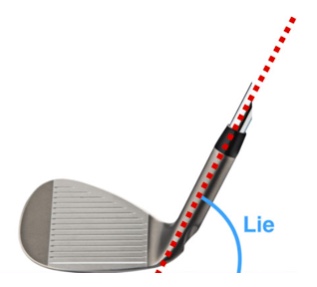
- Lie angle
- Swing weight
- Loft angle
A fitting does not depend on a golfer’s level of play; rather, it is the golfer’s body measurements and swing that determine whether one needs one. With clubs tailored to the golfer, it will be easier to learn the game, play better and have more fun.
The bounce is the part of the wedge that makes contact with the ground.
It is the angle between the leading edge of the wedge and the point where the wedge touches the ground.
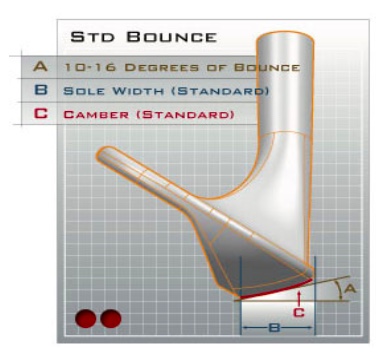
This angle indicates the relationship between the sole of the clubhead and the shaft of the club.
The torque of a shaft refers to the twisting under load along its longitudinal axis.
The following statement generally applies:
- The heavier the weight, the lower the torque
- The heavier the weight, the higher the torque
The kick point is the point on the shaft where the greatest bend occurs. Shaft manufacturers indicate this using the terms ‘Low’, ‘Middle’ and ‘High’.
- High kick point = flat ball flight
- Low kick point = higher ball flight
Gapping involves matching the clubs so that the differences in carrying distance are correct. There should be a difference in carrying distance of 8 to 12 metres between each club.
Any further questions?
Marco Rüdlinger, Head of Fitting at Golfimport, will be happy to answer these at 044 515 39 40.
Ready for the next step?
Book a fitting appointment nowFurther information about golf club fitting at Golfimport:
Further informationfittingknowhow
fittingknowhow